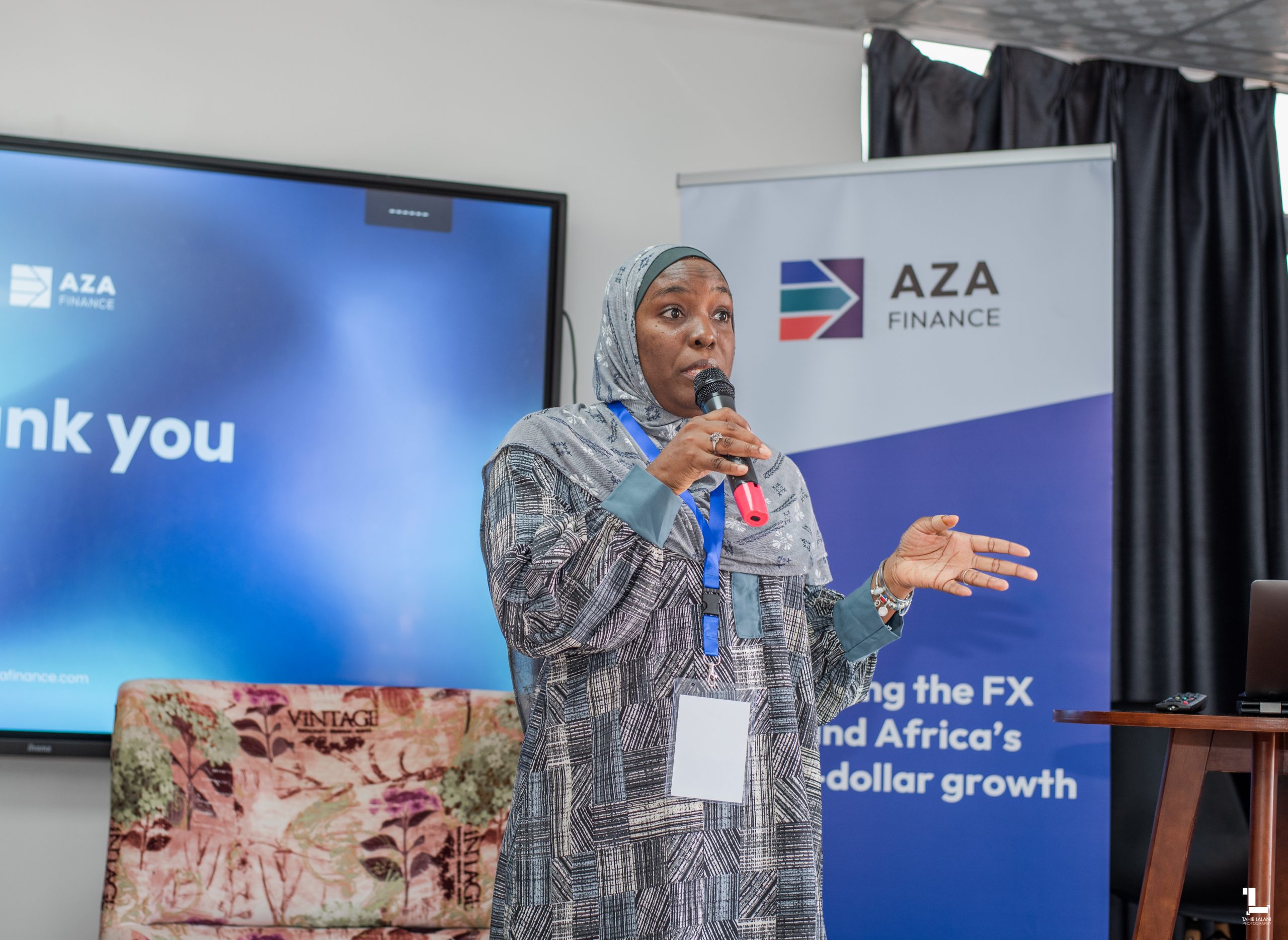
The AZA Finance breakfast networking event “FinTech Fuel Uganda” recently brought together Uganda’s innovative startups and major corporations to discuss the future of cross-border payments.
The event focused on “Improving Efficiency in Cross-Border Payments” and featured experts from MTN Uganda, Airtel Uganda, and AZA Finance. These industry leaders shared their insights on the current state of cross-border payments, the challenges and what they expect the future of cross-border payments will look like. Here are the highlights and key takeaways from the event.
Fatumah Shamim Kavuma, Manager of International Remittances & Interoperability, MTN MoMo Uganda; Luise Karamagi, Lead of International Money Transfer, Airtel Uganda; Fatimah Gana-Mahmoud, Head of Sales for West & Central Africa, AZA Finance

Fatumah Shamim Kavuma, Manager of International Remittances & Interoperability, MTN MoMo Uganda; Luise Karamagi, Lead of International Money Transfer, Airtel Uganda; Fatimah Gana-Mahmoud, Head of Sales for West & Central Africa, AZA Finance
The current state of cross-border payments in Uganda
Fatimah Gana-Mahmoud, our Head of Sales for West & Central Africa, kicked off the discussion by highlighting significant improvements in settlement times in Uganda. “We have seen a huge improvement in terms of settlement times in Uganda. Transaction processing that used to happen between weeks is now happening in days,” she said.
Fatumah Shamim Kavuma, Manager of International Remittances & Interoperability, MTN MoMo Uganda, also highlighted the significant amount of money coming into Uganda. “We have seen growth of up to 1.4 Billion USD come into the Ugandan market, majorly from the Middle East, Europe, and the UK. If we do the conversion to Ugandan shillings, having 5.5 trillion Ugandan Shillings in terms of remittances is quite big,” she explained. This shows how important cross-border payments are for Uganda’s economy.

Fatumah Shamim Kavuma, Manager of International Remittances & Interoperability, MTN MoMo Uganda
Overcoming challenges and seizing opportunities
The panelists also discussed the hurdles businesses face with cross-border payments, like, slow settlement times, high fees, lack of secured payments process, poor infrastructure, and lack of access to liquidity in African currencies were highlighted as significant barriers.
Addressing these challenges, Fatimah stressed the importance of infrastructure. “Without the right infrastructure, it’ll be almost impossible to carry out seamless cross-border payments. Leverage on other partner infrastructure to be able to expand your coverage or presence to give you a wider clientele base in terms of your operations,” she advised. She elaborated that partnerships between regulators, fintechs, banks, and mobile network operators are crucial in eliminating inefficiencies and enhancing cross-border transaction visibility across the continent.
Fintechs like AZA Finance are at the forefront of this transformation. By providing secure payment services, payment infrastructure tailored for the African market, and access to liquidity in multiple currencies, we are significantly improving the state of cross-border payments for African countries. Our presence in over 115 markets and execution of more than US$9 billion in settlements is a testament to our impact. Also, collaborations with banks and telcos like MTN and Airtel make it even easier to facilitate seamless cross-border payments across Africa.
The promising future of cross-border payments in Africa
Luise Karamagi, Lead of International Money Transfer at Airtel Uganda, expressed optimism about the future of cross-border payments in Africa. “The future for cross-border payments in Africa is promising because of the huge penetration of phone usage and mobile money services. This can grow more through regional partnerships and integrations and expansion of the mobile corridors,” she stated, highlighting the transformative potential of mobile technology on payments.

Luise Karamagi, Lead of International Money Transfer, Airtel Uganda
Financial inclusion through better payments
When discussing how more efficient cross-border payments translate to higher levels of financial inclusion, Luise pointed to the role of Open APIs. “Through the Open API, we’re able to seamlessly integrate different financial institutions and provide a wonderful service,” she said. Access to open and secure APIs, compliant with GDPR, not only facilitates integration but also helps reduce financial crime and money laundering risks and provides better financial services.
Fatumah echoed these sentiments, envisioning a global village in terms of money transfers. “For Uganda in particular, we are looking at connecting Uganda to the globe or opening up Uganda to the world,” she remarked.
Fatimah wrapped up the discussion by looking ahead. “We look forward to seeing better digitisation in the future, more financial inclusion, leveraging on technology, and other partner infrastructure to scale. More intra-African trade being carried out across the continent will help businesses to scale their operations and open up several countries without having restrictions in terms of the clients they acquire or the markets they operate in.”
The FinTech Fuel Uganda event highlighted the landscape of cross-border payments in Africa. With ongoing innovations and strategic partnerships, the future of cross-border payments in Uganda and the broader continent looks bright. As businesses continue to leverage these advancements, we can expect to see increased financial inclusion, more efficient trade, and a stronger, more connected Africa.
Watch the event highlights here:
To get started on your cross-border payments, click here to speak to our payment experts.